How to Identify AEM CEM and Monovalent Selective Membranes
A practical guide to membrane identification and installation direction for YASA ET electrodialysis membranes.
Before assembling an electrodialysis stack, confirm whether each sheet is an anion exchange membrane (AEM) or a cation exchange membrane (CEM).
AEM and CEM identify
What AEM and CEM mean
An AEM preferentially transports negatively charged ions, such as chloride. A CEM preferentially transports positively charged ions, such as sodium. Their names describe the ions they transport, rather than the charge of the fixed groups inside the membrane.
For the YASA ET ED membranes, the identification convention is simple:
AEM has no cut corner; CEM has a cut corner.
The standard ED membranes described in the supplied reference do not require a particular face to point toward an electrode. The corner cut identifies the membrane type;

Confirm the membrane model and supplied instructions before applying this rule to another batch or membrane series.
Feature | AEM | CEM |
Full name | Anion exchange membrane | Cation exchange membrane |
Ions transported | Anions such as chloride | Cations such as sodium |
Fixed groups in the membrane | Positively charged | Negatively charged |
ED identification convention | No cut corner | Cut corner |
Identify the two sides of the Bipolar membrane
Bipolar membranes are directional: during installation, the anion exchange side must face the positive electrode (anode), and the cation exchange side must face the negative electrode (cathode);
Incorrect orientation will cause membrane delamination and damage the bipolar membrane.
To identify the two sides of the bipolar membrane shown, place the membrane with its cation exchange (CEM) side facing upward; the cut corner should be at the upper right.

In addition to the cut-corner marking, the following methods can also be used for identification:
The model code printed side is the Anion Exchange (AEM) side.
This CEM side is relatively smooth, while the anion exchange side(AEM) is relatively rough.
Alternatively, apply a drop of approximately 1% methylene blue solution to each surface and wipe it off with paper: the cation exchange side retains a blue stain, while the anion exchange side does not.
Identify AEM and CEM with methylene blue solution
Monovalent selective AEM and CEM Identify method
Monovalent selective membranes are directional
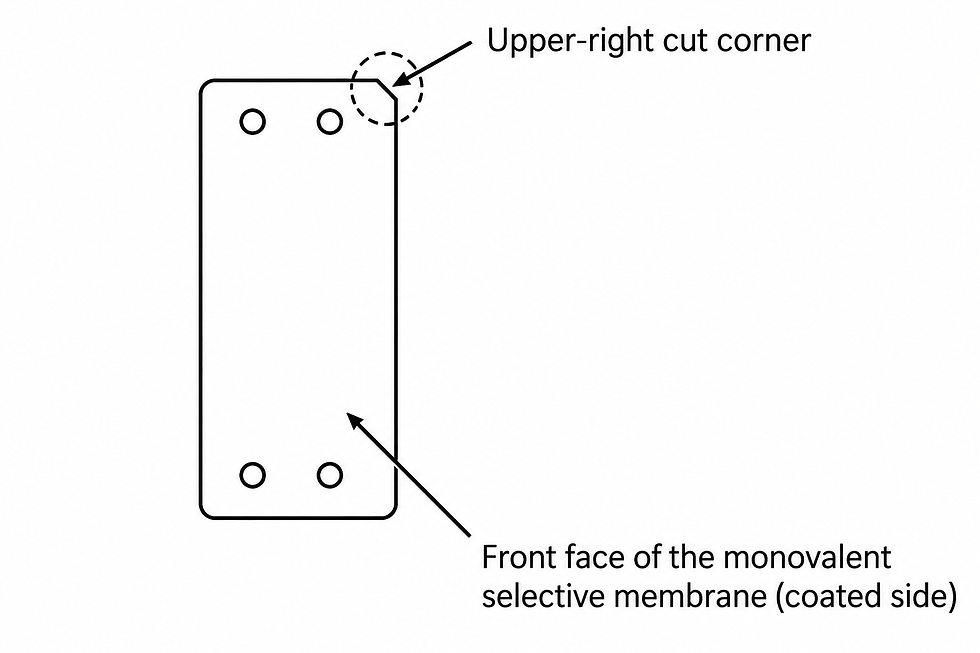
The monovalent selective membranes covered by the same reference have a coating on one surface.
This coated surface is the front face and must face the diluate compartment, also called the desalination compartment.
The ions leaving the diluate enter the membrane through this coated face.

Both monovalent selective AEM and CEM follow this orientation convention.
For these monovalent selective membranes, the model code printed side identifies the coated front face.
When that face is upward, the reference convention places the cut corner at the upper right.
A short check before stack assembly
Read the membrane model and package label and separate the AEM and CEM sheets.
Confirm whether the sheet is a standard ED membrane or a monovalent selective membrane.
For standard ED sheets under this convention, check AEM without a cut corner and CEM with a cut corner.
For Bipolar membranes, during installation, the anion exchange side must face the positive electrode (anode), and the cation exchange side must face the negative electrode (cathode).
For monovalent selective sheets under this convention, identify the cut corner or coded coated face and position it toward the diluate compartment.
Follow the stack drawing for the membrane sequence, spacers and flow ports. If the label and physical mark disagree, obtain confirmation before assembly.
Comments